
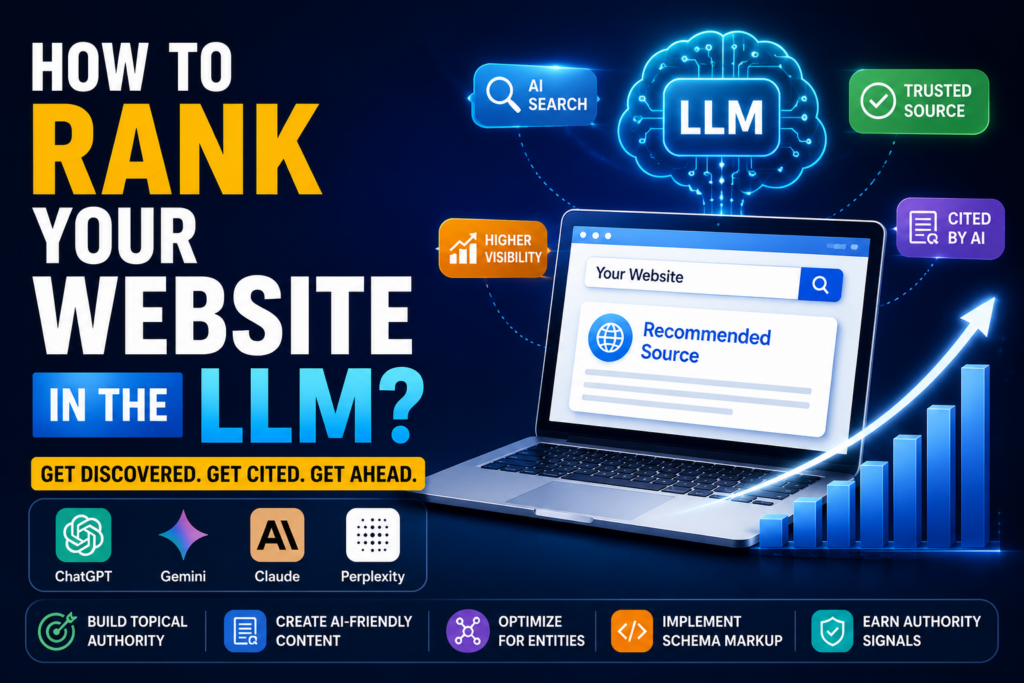
Artificial Intelligence is changing how people discover information online. Today, users are increasingly asking questions directly to AI platforms such as ChatGPT, Google Gemini, Claude, and Perplexity instead of searching through traditional search engine results. This shift has created a new challenge and opportunity for businesses: How to Rank Your Website in the LLM environment. Companies that optimize their websites for Large Language Models (LLMs) can gain visibility in AI-generated answers, recommendations, summaries, and citations.
In this guide, we’ll explain exactly how to rank your website in the LLM ecosystem using modern SEO and Generative Engine Optimization (GEO) strategies.
Understanding LLM Ranking
What Does “Rank Your Website in the LLM” Mean?
Definition:
Ranking in LLMs means increasing the likelihood that AI systems reference, cite, recommend, or extract information from your website when generating responses to user queries.
Unlike traditional SEO, LLM visibility depends on:
- Content quality
- Entity recognition
- Brand authority
- Structured data
- Topical expertise
- Citation frequency across the web
The Problem Statement
Many businesses still focus only on Google rankings.
However:
| Traditional SEO | LLM Optimization (GEO) |
|---|---|
| Ranks pages | Ranks knowledge |
| Keywords matter most | Entities matter most |
| Links drive authority | Citations drive authority |
| Clicks are the goal | Mentions and recommendations are the goal |
| SERP visibility | AI answer visibility |
Without GEO optimization, your website may never appear in AI-generated responses.
Why LLM Visibility Matters
Key Benefits
1. Increased Brand Authority
AI assistants often recommend trusted sources.
2. More Qualified Leads
Users asking AI tools often have high purchase intent.
3. Future-Proof Marketing
AI-driven search is growing rapidly.
4. Better Organic Visibility
Strong GEO usually strengthens traditional SEO.
5. Higher Trust Signals
Being cited by AI tools improves perceived expertise.
How LLMs Choose Sources
Most AI systems evaluate:
Content Quality
- Original research
- Expert insights
- Accurate information
Entity Recognition
AI understands entities better than keywords.
Examples:
- Companies
- Locations
- Products
- Services
- Industry experts
Authority Signals
- Backlinks
- Brand mentions
- Reviews
- Citations
Structured Information
- Schema markup
- FAQs
- Lists
- Tables
Step-by-Step Process to Rank Your Website in the LLM
Step 1: Build Topical Authority
Create topic clusters around your niche.
Example for an SEO Agency:
Main Topic:
- AI SEO
Supporting Topics:
- GEO Services
- AI Search Optimization
- ChatGPT SEO
- Gemini Optimization
- Claude SEO
- Voice Search SEO
The more complete your topical coverage, the more likely LLMs recognize your expertise.
Step 2: Create AI-Friendly Content
LLMs prefer content that is:
- Clear
- Structured
- Fact-based
- Easy to cite
Use:
Question-Based Headings
Example:
How Does ChatGPT Select Sources?
What Is Generative Engine Optimization?
Why Is Entity SEO Important?
These formats are frequently used in AI answers.
Step 3: Optimize for Entities
Instead of targeting only keywords:
Target entities such as:
- OpenAI
- Anthropic
- Microsoft
- SEO
- GEO
- AI Search
- Voice Search
Entity-rich content improves AI understanding.
Step 4: Implement Schema Markup
Recommended schemas:
- FAQ Schema
- Article Schema
- Organization Schema
- Local Business Schema
- Author Schema
- Breadcrumb Schema
Schema helps AI systems interpret content correctly.
Step 5: Demonstrate E-E-A-T
Google and AI systems prioritize:
Experience
Share real project examples.
Expertise
Publish expert-written content.
Authoritativeness
Build industry recognition.
Trustworthiness
Use transparent business information.
Step 6: Earn High-Authority Mentions
Get featured on:
- Industry publications
- Business directories
- News websites
- Niche blogs
AI systems frequently learn authority from web-wide citations.
Step 7: Optimize for Conversational Queries
Instead of:
“SEO Services”
Use:
- What are the best SEO services for startups?
- How much do SEO services cost?
- How can local businesses improve SEO?
These match real AI interactions.
Features of AI-Optimized Content
Essential Characteristics
✔ Entity-rich
✔ Well-structured
✔ Factually accurate
✔ Comprehensive
✔ Frequently updated
✔ Includes FAQs
✔ Uses schema markup
✔ Demonstrates expertise
Common Mistakes to Avoid
Keyword Stuffing
LLMs prioritize meaning over repetition.
Thin Content
Short generic articles rarely get cited.
No Structured Data
Schema remains essential.
Ignoring Brand Authority
Authority is increasingly important.
Poor Content Organization
AI systems prefer organized information.
Best Practices for GEO Success
Publish Original Research
Unique data attracts citations.
Create Definitive Guides
Long-form resources perform best.
Update Content Frequently
Fresh information improves trust.
Build Personal Brands
Expert authors increase authority.
Use Comparison Tables
AI tools often cite structured comparisons.
Industry Trends in 2026
Trend 1: AI Search Growth
AI-generated answers continue replacing traditional searches.
Trend 2: Entity SEO Expansion
Entities are becoming more important than exact-match keywords.
Trend 3: Zero-Click Experiences
Users increasingly receive answers without visiting websites.
Trend 4: GEO Becomes Essential
Generative Engine Optimization is becoming a core digital marketing strategy.
Case Study Example
Local SEO Agency Example
Situation:
- Low organic visibility
- No AI citations
Actions:
- Built topical clusters
- Added FAQ schema
- Published expert content
- Earned industry mentions
Results:
- Increased organic traffic
- More branded searches
- Greater AI visibility
- Improved lead quality
Frequently Asked Questions
What is LLM SEO?
LLM SEO is the process of optimizing content for AI systems like ChatGPT, Gemini, Claude, and Perplexity.
What is GEO?
Generative Engine Optimization helps content become discoverable and citeable in AI-generated responses.
Does traditional SEO still matter?
Yes. Strong SEO supports GEO performance.
Can ChatGPT rank websites?
ChatGPT doesn’t rank websites like Google but may reference trusted sources.
How do AI tools choose sources?
They evaluate authority, relevance, content quality, and structured information.
Is schema markup important?
Yes. Schema helps AI understand page context.
What content works best for AI search?
Comprehensive, authoritative, and structured content.
Are backlinks still important?
Yes. Authority signals remain valuable.
How often should content be updated?
Review and update critical content every 3–6 months.
Is GEO replacing SEO?
No. GEO complements SEO.
What industries benefit most?
Healthcare, SaaS, Finance, Real Estate, E-commerce, and Local Services.
Does brand authority affect AI visibility?
Yes. Strong brands are cited more often.
The future of digital visibility is no longer limited to search engine rankings. Businesses that understand How to Rank Your Website in the LLM ecosystem will gain a competitive advantage as AI-powered search continues to grow.
By combining SEO, GEO, entity optimization, structured data, topical authority, and E-E-A-T principles, your website can become a trusted source for AI assistants and search engines alike.
Want your business to appear in AI-generated answers from ChatGPT, Gemini, Claude, and Perplexity?
Partner with Invincible Virtual Services to implement advanced GEO and SEO strategies that increase visibility, authority, and lead generation in the AI search era.
Summary
This guide explains how businesses can rank their websites in the LLM ecosystem by combining SEO, GEO, entity optimization, structured data, topical authority, E-E-A-T principles, and AI-friendly content strategies. The article provides actionable steps, industry trends, best practices, FAQs, and optimization recommendations for ChatGPT, Gemini, Claude, and Perplexity.
